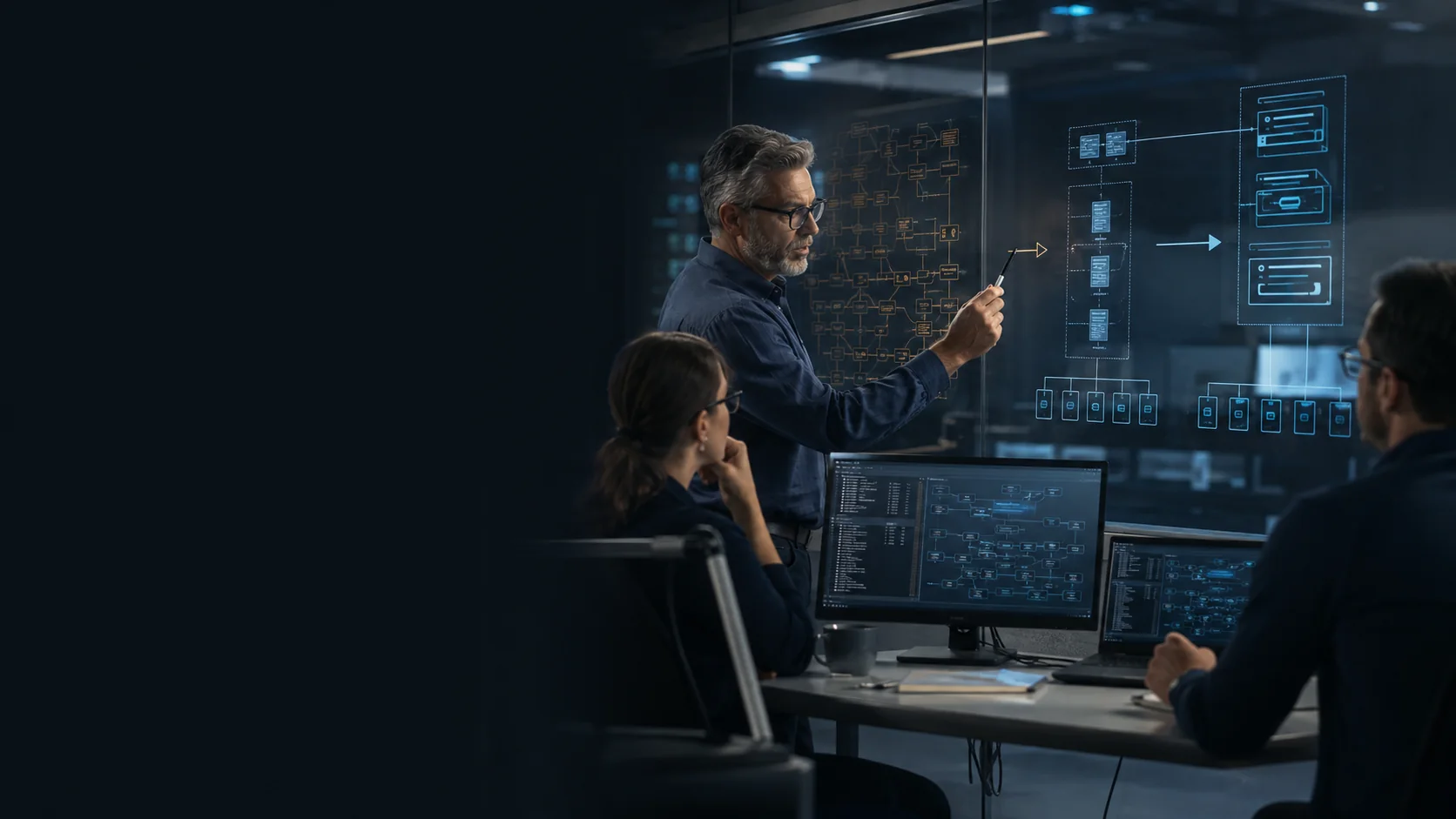
Engineering team modernizing a business-critical legacy application

Legacy Application Modernization Services

Replace what has become unchangeable, engineered on behavior reconstructed from code, anti-corruption boundaries, reconciled data migration and independently reversible cutover.

What Legacy Application Modernization Services Deliver

The Discipline

Legacy application modernization services replace or restructure an application that still works but can no longer be safely changed. The technical problem is rarely the language or the framework. It is that the system encodes years of business rules nobody wrote down, and the cost of any change is dominated by the risk of disturbing a rule whose existence is only discovered when it stops firing.

Our Approach

Behavior comes before architecture. We reconstruct what the application actually does from code, data and observed traffic, and document it before proposing a target. Replacement then proceeds component by component behind a seam, with the existing system operating until each replacement has been proven against it.

The Evidence

A 2025 survey of more than 500 United States IT professionals conducted by Saritasa found that 62 percent of organizations still rely on legacy software systems. Forty-three percent named security vulnerabilities as a major concern, and 68 percent depend on their internal IT team to maintain those systems, concentrating knowledge in the group with the least capacity to replace them.

Saritasa, Legacy Software Modernization in 2025

What does a legacy modernization engagement actually settle?

  1. Behavioral Baseline

    What the system currently does, including the rules nobody can explain, recorded before anything is replaced. Without this, undocumented behavior resurfaces as a production defect and is attributed to the new system.

  2. Seam Placement

    Where the boundary between old and new sits, and how traffic moves across it. A modernization without a seam is a rewrite, and it delivers nothing until it delivers everything.

  3. Data Authority

    Which system owns each entity during the transition, and how divergence is detected while both are running. Programs that leave this ambiguous reconcile forever.

Where Legacy Modernization Projects Usually Begin

  1. Unsupported Dependency

    A framework, runtime or database version has reached end of support, so security patches have stopped and the upgrade path requires code changes nobody is confident making.

  2. Knowledge Concentration

    One or two people understand the system, and the business has quietly organized around their availability. The risk is now a personnel risk rather than a technical one.

  3. Change Cost Inflation

    Each feature costs more than the last because it is implemented around constraints rather than through them, and delivery data shows the trend before anyone attributes it to architecture.

  4. Integration Refusal

    A system the business wants to adopt cannot connect, so it arrives with a manual process attached that becomes permanent.

  5. Failed Upgrade Attempt

    An in-place upgrade was attempted, encountered behavior nobody expected, and was rolled back. The estate now carries both the original problem and the memory of the attempt.

  6. Audit or Compliance Trigger

    A requirement the system was never designed for is being met through procedure, and an auditor has asked for evidence rather than assurance.

  7. Vendor or Platform Exit

    The supplier is end of life, has been acquired, or has moved its roadmap somewhere the business cannot follow.

Why Choose Innogent Technologies for Legacy Application Modernization Services

Why businesses build with Innogent
01

Behavior Reconstructed Before Replacement

What the application does is established from code, data and traffic analysis and written down first. AI-assisted comprehension makes this materially faster on undocumented codebases, which is where it earns its place.

Certifications

  • CMMI Level 5 Appraised
  • ISO 27001:2013
  • ISO 20000-1:2018
  • ISO 9001:2015
100+Projects Delivered
50+Global Clients
10+Years of Engineering Excellence

Legacy Application Modernization Solutions We Deliver

  1. Framework and Runtime Migration

    Moving an application off an unsupported runtime, framework or language version while preserving behavior, with test coverage established first so the migration can be verified rather than hoped for.

  2. Monolith Decomposition

    Extracting capability from a single deployable into independently changeable services, with boundaries drawn around business invariants rather than around database tables.

  3. Database and Schema Modernization

    Replacing an end-of-life database or an unfit schema, with change data capture keeping both stores consistent during the transition.

  4. Interface and Experience Replacement

    Rebuilding the user interface against a stable backend, delivered surface by surface so the operating application continues throughout.

  5. Cloud Re-Architecture

    Restructuring an application designed for fixed infrastructure into one that uses managed services, elastic capacity and modern deployment topology.

  6. Business Rule Extraction

    Recovering embedded logic from procedural code or stored procedures into an explicit, testable rule layer the business can inspect and change.

How We Assess a Legacy Application

Assessment dimensionWhat we examineWhat it determines
Behavioral inventoryCode paths, stored procedures, scheduled jobs, integration endpoints and observed production trafficWhich behavior must be preserved, including rules nobody can currently explain
Structural conditionCoupling, cyclomatic complexity, duplication, dead code and existing test coverageWhether refactoring is viable or the structure itself prevents safe change
Dependency currencyFramework, runtime, library and database versions against their support statusWhich upgrades are mandatory, which are optional, and what the security exposure is today
Change and defect historyWhere changes concentrate and where defects recur, drawn from version control and ticket historyWhich components carry the cost, which are stable and can be left alone
Data quality and ownershipSchema condition, referential integrity, duplication and which system is authoritative per entityMigration effort, reconciliation design and how much data remediation precedes the move
Operational costLicensing, infrastructure, support effort and the engineering time absorbed keeping it runningThe five-year cost of doing nothing, which is the number the build case is measured against

Data Migration and Cutover Design

  1. Authority Assignment

    Which system owns each entity at each stage of the transition, so that both systems never believe they are authoritative for the same record.

  2. Change Data Capture

    Ongoing replication between old and new while both operate, so the replacement is populated continuously rather than through a single high-risk migration event.

  3. Remediation Before Migration

    Referential integrity failures, duplicates and encoding problems resolved in the source before the move, since migrating bad data faithfully reproduces the problem in a system that was supposed to solve it.

  4. Automated Reconciliation

    Continuous comparison between the two systems on record counts, balances and business-level totals, with divergence raised as an alert rather than found in a report.

  5. Staged User Migration

    Users moved in cohorts with the previous system remaining available, so a problem affects a group rather than the business.

  6. Rollback Position

    A tested return path at every stage, retired only once the replacement has operated cleanly through a full business cycle including period close.

Legacy Application Modernization Scope, Timeline and Cost

Legacy application modernization engagements, coverage, timelines and typical delivery teams
EngagementWhat it coversTimelineTeam
Legacy AssessmentBehavioral inventory, structural and dependency analysis, disposition, sequence, reconciliation design and cost comparison3 to 5 weeks1 architect, 2 engineers, 1 analyst
Framework or Runtime MigrationMoving off an unsupported runtime or framework with behavior preserved and test coverage established first10 to 20 weeks3 to 5 engineers, 2 QA
Interface ReplacementRebuilding the user interface surface by surface against a stable backend12 to 24 weeks4 to 6 engineers, 1 designer, 2 QA
Incremental Re-ArchitectureComponent-by-component replacement behind a seam, with parallel running and reconciliation24 to 48 weeks6 to 10 engineers, 1 architect, 3 QA, 1 DevOps
Data and Schema MigrationRemediation, change data capture, reconciliation and staged cutover8 to 20 weeks3 to 5 engineers, 1 data specialist, 2 QA

What Determines Legacy Application Modernization Cost

Cost depends on the requirement: how much behavior is undocumented and must be reconstructed, existing test coverage, the number and condition of integration points, the volume and quality of data to be migrated, and how much continuity the business requires during cutover. Innogent Technologies issues an estimate after the assessment, alongside the scope it derives from.

Why Undocumented Behavior Drives the Estimate

Two applications of identical size can differ severalfold in modernization cost purely on how much of their behavior is written down. A well-documented system with test coverage is a migration exercise. An undocumented one is an investigation followed by a migration, and the investigation is not compressible by adding engineers. This is the variable most often left out of estimates and most often responsible for overrun.

Our AI-Enabled Legacy Application Modernization Process

  1. Step 1

    Behavioral Reconstruction

    Code, data and production traffic analyzed to establish what the system does. AI-assisted comprehension applied to undocumented code, with findings verified by engineers

    2 to 4 weeks
  2. Step 2

    Assessment and Disposition

  3. Step 3

    Safety Net

  4. Step 4

    Seam and Foundations

  5. Step 5

    Incremental Replacement

  6. Step 6

    Cutover and Decommission

Technology Stack for Legacy Application Modernization

  1. 01

    Analysis

    • Static analysis
    • Dependency graphing
    • SonarQube
    • OpenRewrite
    • AI-assisted code comprehension
  2. 02

    Legacy platforms

    • Java EE
    • .NET Framework
    • Classic ASP and VB
    • PL/SQL and T-SQL
    • PHP
    • COBOL interfacing
  3. 03

    Target backend

    • Java and Spring Boot
    • .NET
    • Node.js
    • Python
    • Go
  4. 04

    Target frontend

    • React
    • Next.js
    • Angular
    • TypeScript
  5. 05

    Data and migration

    • PostgreSQL
    • SQL Server
    • Oracle
    • MongoDB
    • Debezium
    • Flyway
    • Liquibase
  6. 06

    Seams and integration

    • API gateway routing
    • Anti-corruption layers
    • Apache Kafka
    • Message brokers
  7. 07

    Testing

    • Characterization and approval testing
    • Testcontainers
    • Playwright
    • JUnit and xUnit
  8. 08

    Delivery and observability

    • Docker
    • Kubernetes
    • Terraform
    • GitHub Actions
    • Datadog
    • OpenTelemetry

Legacy Application Modernization FAQs

Answers about undocumented systems, modernization timelines and cost, business continuity, incremental replacement, historical data and assessment ownership.

What are legacy application modernization services?

Legacy application modernization services replace or restructure an application that still works but can no longer be safely changed. Innogent Technologies reconstructs and documents what the system actually does before proposing a target, then replaces it component by component behind a seam while the existing system continues operating.

How do you modernize a system nobody fully understands?

Behavior is reconstructed from code, data and observed production traffic, with AI-assisted comprehension applied to undocumented code and findings verified by engineers. Characterization tests are then written against current behavior so any change can be verified rather than assumed. Innogent Technologies does not begin replacing a system whose behavior has not been established.

How long does legacy application modernization take?

A legacy assessment runs 3 to 5 weeks. A framework or runtime migration takes 10 to 20 weeks, an interface replacement 12 to 24 weeks, and an incremental re-architecture 24 to 48 weeks. Data and schema migration runs 8 to 20 weeks depending on volume and data quality.

How much does legacy application modernization cost?

Cost depends on the requirement: how much behavior is undocumented, existing test coverage, the number and condition of integration points, the volume and quality of data to be migrated, and the continuity required during cutover. Innogent Technologies issues an estimate after the assessment, alongside the scope it derives from.

Can the business keep running during modernization?

Yes. Replacement proceeds component by component behind a routing or integration seam, with change data capture keeping both systems consistent and automated reconciliation detecting divergence. Users migrate in cohorts, and a tested rollback exists at every stage until the replacement has operated cleanly through a full business cycle.

Should we modernize incrementally or rewrite from scratch?

Incremental replacement is the default, because a rewrite delivers nothing until it delivers everything and carries the risk of losing undocumented behavior. A rewrite is warranted where the application is small enough, or where its architecture prevents a seam from working. Innogent Technologies gives that recommendation during assessment.

What happens to our historical data?

Data is remediated in the source before migration, since migrating poor data faithfully reproduces the problem in the new system. Change data capture keeps both stores consistent during the transition, and automated reconciliation compares record counts, balances and business-level totals continuously rather than at cutover.

Do we have to use you for the implementation?

No. The assessment produces a behavioral baseline, a component-level disposition, a sequence, a reconciliation design and a five-year cost comparison. That output is yours whether or not the build proceeds with Innogent Technologies.

Start Your Legacy Application Modernization Engagement

A short call establishes what the system does, what is known about how it does it, and whether the right first step is an assessment, a targeted migration or leaving it alone.

  • Onboard in 48-72 Hours

  • Start With a Trial Sprint

  • 10+ Years of Engineering Expertise

  • Experience Across Global Markets

Get in Touch

Bring us your ideas, your toughest challenges, or just a blank canvas. We can make it work and excel together.

Fields marked * are required.