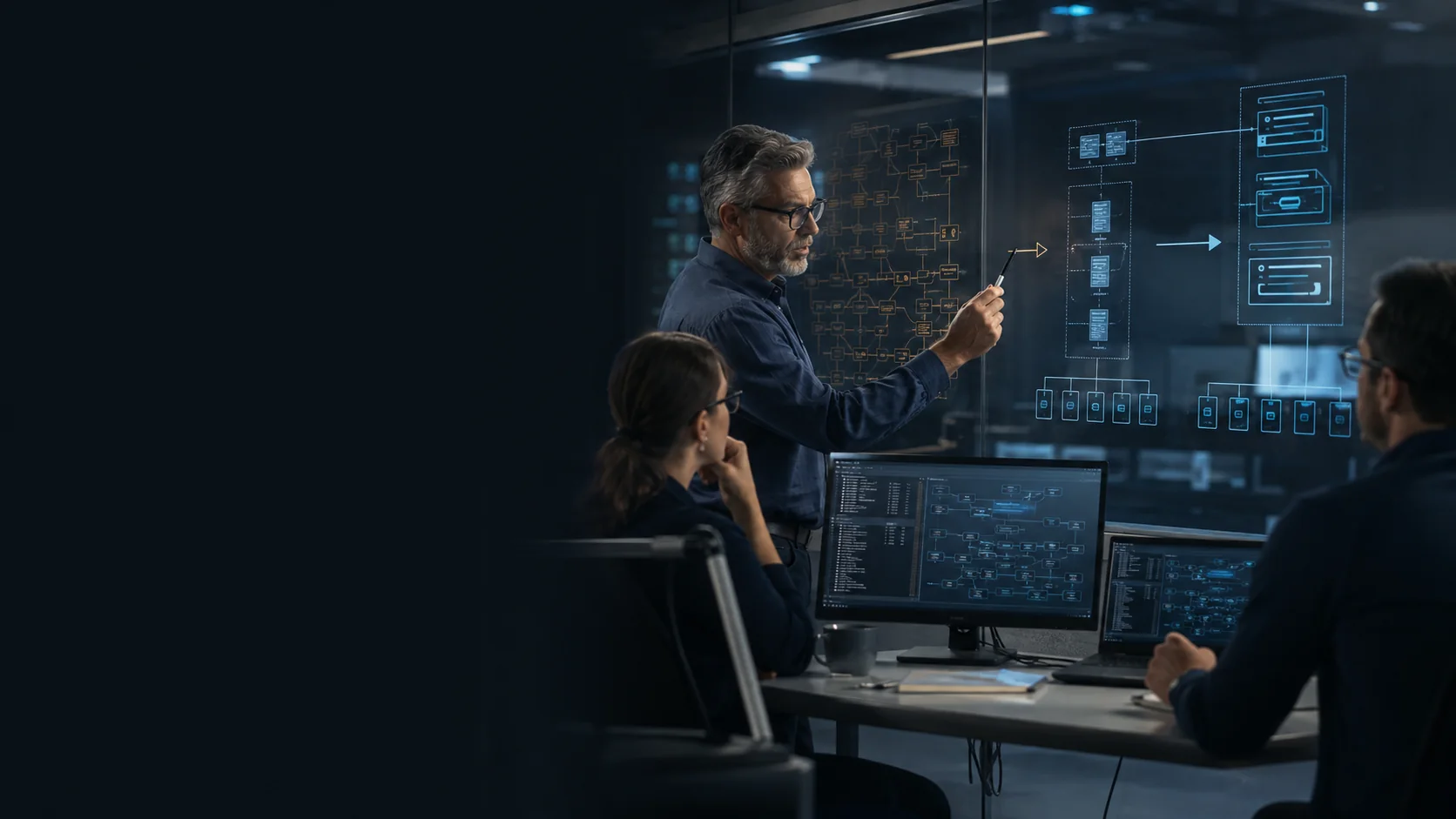
Engineering team planning the modernization of a legacy system

IT Modernization Services

Systems nobody wants to touch become systems your team can change, with dependencies mapped, risk sequenced and business continuity protected before anything moves.

What IT Modernization Services Deliver

The Discipline

IT modernization services restore the ability to change software that has become too expensive or too risky to alter. The systems in question usually work. That is precisely what makes the decision difficult: nothing is visibly broken, the cost of ownership is absorbed quietly across several budget lines, and the constraint only becomes explicit when a competitor ships something in six weeks that would take you two quarters.
Our Approach

Modernization begins with a portfolio assessment rather than a technology choice. Each application is placed against a disposition, the dependencies between them are mapped, and the sequence is set so that revenue-carrying capability keeps operating throughout. Nothing is replaced because it is old; it is replaced because the assessment shows replacement is cheaper than continuing.

What does a modernization program actually settle?

  1. Application Disposition

    Which systems are retained as they are, extended, rebuilt, replaced with a product, or retired outright. Portfolios without this settled modernize whatever is loudest rather than whatever matters.

  2. Execution Sequence

    What runs first, what each item depends on, and which items cannot start until an architectural or data problem is dealt with. Most modernization programs fail here rather than on ambition.

  3. Continuity Boundary

    Which capabilities must keep operating without interruption and what that requirement costs in parallel running, reconciliation and rollback design. Programs that leave this implicit discover it during cutover.

Why Choose Innogent Technologies for IT Modernization Services

Why businesses build with Innogent
01

Assessment Before Recommendation

The disposition of each application is established from code, dependency and cost analysis before any approach is proposed. A recommendation produced before the estate has been read is a preference, not an assessment.

Certifications

  • CMMI Level 5 Appraised
  • ISO 27001:2013
  • ISO 20000-1:2018
  • ISO 9001:2015
100+Projects Delivered
50+Global Clients
10+Years of Engineering Excellence

IT Modernization Approaches We Apply

IT modernization approaches, what they involve, when they are appropriate, and what they do not address
ApproachWhat it involvesWhen it is the right callWhat it does not fix
RetainLeave the application as it is, with the decision documented and revisited on a scheduleThe system is stable, changes rarely, and its cost of ownership is genuinely lowNothing. This is a decision to accept the current position
RehostMove the workload to modern infrastructure without changing the applicationHardware or hosting is end of life and the application itself is soundArchitecture, changeability or the cost of making changes
ReplatformChange the runtime, database or middleware without restructuring the applicationA dependency is unsupported but the application logic remains fit for purposeCoupling, test coverage or the underlying domain model
RefactorRestructure the code and improve test coverage while preserving behaviorThe logic is correct but the structure prevents safe changeFundamental architectural constraints or an unfit data model
Re-architectRedesign boundaries, data model and integration while retaining proven business rulesThe domain is well understood but the architecture caps what the business can doBusiness rules nobody can currently explain
RebuildConstruct a replacement from the requirements the existing system impliesThe system's behavior is understood and the implementation is beyond repairThe risk of losing undocumented behavior; that must be recovered first
ReplaceRetire the system in favor of a productThe process is standard and a mature product covers itProcess differentiation the business actually competes on

Why the Disposition Comes Before the Approach

Most portfolios need four or five of these applied to different applications, and applying one approach across an estate is how modernization programs consume budget without changing the constraint. Disposition is decided per application from dependency analysis, change frequency, defect concentration and cost of ownership, and the reasoning is recorded so a later team can tell a decision from an inheritance.

What Deferral Actually Costs

Deferring modernization is a legitimate commercial decision. It is rarely a free one, and the costs accrue in places that do not appear as a modernization line item.

  1. Change Cost Inflation

    Every feature costs more than the last because it is implemented around constraints rather than through them. The trend is visible in delivery data long before anyone attributes it to architecture.

  2. Capacity Diversion

    Engineering time absorbed by keeping the system running is time not spent on anything a customer would notice, and it grows as a share of the team rather than staying fixed.

  3. Talent Concentration

    Knowledge of the system narrows to a small number of people, and the risk becomes a personnel risk rather than a technical one. Recruitment for the required skills gets harder each year.

  4. Security Exposure Accumulation

    Unsupported components stop receiving patches, and the remediation options narrow from patching to compensating controls to isolation.

  5. Integration Ceiling

    New systems the business wants cannot connect, so each one arrives with a manual process attached that becomes permanent.

  6. Compliance Drift

    Requirements the system was never designed for are met through procedure rather than through the system, which works until an auditor asks for evidence rather than assurance.

Our AI-Enabled IT Modernization Process

IT modernization process stages

Portfolio Assessment

Application inventory, dependency mapping, code and architecture analysis, change frequency and defect concentration, and cost of ownership per system.

3 to 6 weeks

Technology Stack for IT Modernization

  1. 01

    Analysis and discovery

    • Static analysis tooling
    • Dependency graphing
    • SonarQube
    • OpenRewrite
    • AI-assisted code comprehension
  2. 02

    Target backend

    • Java and Spring Boot
    • .NET
    • Node.js
    • Python
    • Go
  3. 03

    Legacy interoperability

    • COBOL and mainframe interfacing
    • PL/SQL
    • Classic ASP and VB
    • Java EE
    • .NET Framework
  4. 04

    Data

    • PostgreSQL
    • SQL Server
    • Oracle
    • MongoDB
    • Debezium change data capture
  5. 05

    Integration seams

    • API gateway routing
    • Anti-corruption layers
    • Apache Kafka
    • Message brokers
  6. 06

    Cloud and infrastructure

    • AWS
    • Azure
    • Google Cloud
    • On-premises and hybrid
  7. 07

    Delivery

    • Docker
    • Kubernetes
    • Terraform
    • GitHub Actions
    • GitLab CI
  8. 08

    Observability

    • Datadog
    • Grafana
    • Prometheus
    • OpenTelemetry
    • ELK

IT Modernization FAQs

Answers about modernization priorities, cost, business continuity, undocumented systems, replacement decisions and long-term transition.

What are IT modernization services?

IT modernization services restore the ability to change software that has become too expensive or too risky to alter. Innogent Technologies begins with a portfolio assessment that assigns a disposition to each application, maps the dependencies between them, and sets an execution sequence that keeps revenue-carrying capability operating throughout.

How do you decide what to modernize first?

Sequence follows the dependency graph and the risk profile rather than stakeholder preference. Applications are assessed on change frequency, defect concentration, cost of ownership and what depends on them. The system a business most wants replaced is frequently the one that has to move last, because others depend on its data.

How much do IT modernization services cost?

Cost depends on the requirement: the number of applications in scope and their condition, how much behavior is undocumented and must be reconstructed, the integration surface, whether historical data must be migrated and reconciled, and how much continuity is required during cutover. Innogent Technologies estimates after the portfolio assessment.

Can you modernize a system without stopping the business?

Yes, and it is the normal condition. Continuity is engineered through parallel running, reconciliation between old and new, staged migration of users and data, and a defined rollback at each step. The continuity requirement is established during assessment because it materially affects both cost and sequence.

What if nobody understands how the current system works?

This is common and it is addressed during assessment rather than during the build. Behavior is reconstructed from code, data and observed traffic, then documented. Innogent Technologies does not begin replacing a system whose behavior has not been established, because undocumented rules resurface as production defects.

Should we modernize or replace with an off-the-shelf product?

Replace where the process is standard and a mature product covers it. Modernize where the process is a source of competitive advantage or where regulatory constraints exceed what packaged products accommodate. The disposition assigned during assessment answers this per application rather than for the estate as a whole.

Is a full rewrite ever the right answer?

Occasionally, where the system's behavior is well understood and the implementation is beyond repair. More often it is not, because a rewrite carries the risk of losing undocumented behavior and delivers nothing until it delivers everything. Innogent Technologies recommends incremental replacement unless the assessment argues otherwise.

What happens after modernization is complete?

Superseded systems are retired on evidence of zero traffic rather than on a schedule, and runbooks, architecture decision records and knowledge transfer are produced during delivery. Ongoing support is available through Software Support and Maintenance Services where you would rather not carry it internally.

Start Your IT Modernization Engagement

A short call establishes which systems are constraining the business, what has already been attempted, and whether the right first step is a portfolio assessment, a single application or nothing at all.

  • Onboard in 48-72 Hours

  • Start With a Trial Sprint

  • 10+ Years of Engineering Expertise

  • Experience Across Global Markets

Get in Touch

Bring us your ideas, your toughest challenges, or just a blank canvas. We can make it work and excel together.

Fields marked * are required.